Water Extraction in San Marcos, CA
Standing water keeps soaking into pad, baseboard and drywall until it leaves the building. The extraction crew pulls it out with truck-mounted and portable units, then the drying team sets equipment to the readings.
(888) 450-9281Get the San Marcos pump-out started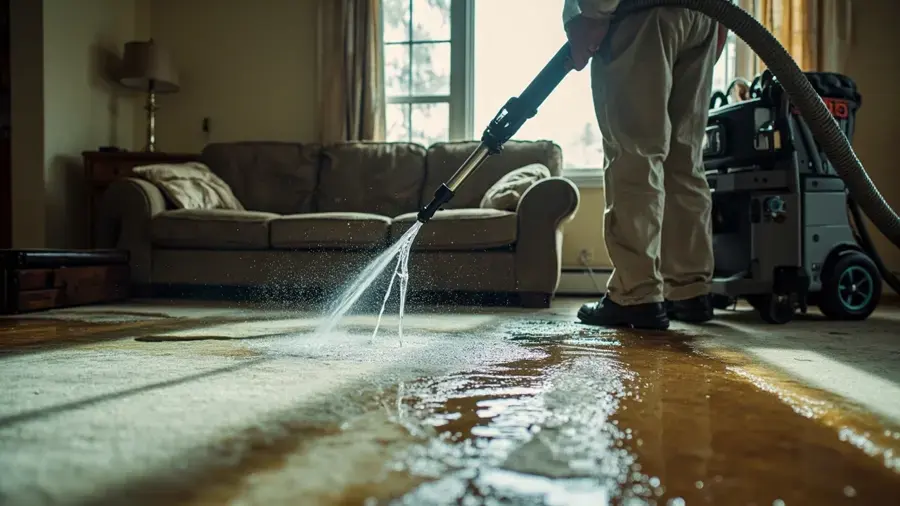
First steps for water extraction
- 1
Stop the source
Close the fixture valve or the main shutoff. On most San Marcos slab homes it sits near the garage or by the front hose bib.
- 2
Kill power to wet circuits
Only if the panel is dry and you can reach it without standing in water.
- 3
Photograph before moving anything
Wide shots and close shots of every wet room help the claim file later.
- 4
Lift what soaks up water
Rugs, boxes and furniture skirts wick water fast. Blocks or foil under legs keep stains off carpet.
How water extraction is handled
Moisture mapping before extraction
The tech who does the walkthrough uses pinless meters and a thermal camera to find where the water traveled under flooring and into walls.
Extraction sized to the flooring
The extraction crew uses a truck-mounted unit for volume and weighted tools on carpet so the pad gives up water, not just the surface.
Drying set to the readings
Air movers and LGR dehumidifiers go in after extraction, and the drying team checks readings daily until the materials reach the drying goal.
What does water extraction cost in San Marcos, CA?
In San Marcos, CA, water extraction and the drying that follows typically run $900 to $5,500, depending on the water category, how many rooms are wet, the flooring type and how fast extraction started.
For a closer planning number, try the water damage cost calculator.
The water extraction process in San Marcos
- 1
Map
The walkthrough tech maps moisture and sets the category and class of the loss.
- 2
Extract
The extraction crew pulls standing water with truck-mounted suction.
- 3
Set equipment
Air movers and LGR dehumidifiers go in, sized to each room's evaporation load.
- 4
Verify
Daily readings continue until materials sit within the drying goal.
Why extraction comes before anything else
Every hour water sits on a floor, more of it moves into carpet pad, baseboards, the bottom of drywall and the gap under cabinets. Air movers cannot evaporate a puddle efficiently, so extraction does the heavy lifting: a truck-mounted unit removes far more water per pass than a shop vacuum, and it leaves the building through the hose instead of spreading to the next room.
San Marcos homes are mostly slab-on-grade, so water that reaches the floor has nowhere to drain. It spreads sideways under laminate and engineered wood and wicks into the tack strip at the carpet edge. That is why the extraction crew works the whole wet footprint shown on the moisture map, not just the spot that looks wet.
What gets extracted, and what gets removed
- Carpet on clean water: often extracted with weighted tools and dried in place, pad included, when drying starts fast.
- Carpet on gray or black water: the pad is removed, and porous materials touched by Category 3 water get removed, not dried.
- Laminate and floating floors: water trapped underneath usually means pulling planks so the slab can dry.
- Tile and sealed concrete: extracted and dried quickly, with grout lines and wall bottoms checked with meters.
After the water is out
Extraction ends the flood, and structural drying finishes the job. The drying team runs air movers and LGR dehumidifiers and records readings every day, comparing wet materials to a dry reference in an unaffected room. The EPA WaterSense leak basics explain how much water a small household leak can waste, and Ready.gov flood safety covers electrical and health precautions around standing water. When the source is a slab leak, see slab leak water damage; for the full dry-out, see structural drying.
Water extraction across San Marcos
The San Marcos restoration crew covers the whole city, including San Elijo Hills, Discovery Hills, Lake San Marcos, Twin Oaks Valley, Santa Fe Hills, Old Creek Ranch, plus ZIP codes 92069, 92078, 92079, 92096, and the edges of Escondido, Vista and Carlsbad.
See every area and ZIP coveredWater extraction questions
Standing water keeps spreading until it is pulled out, so extraction is worth starting right away.
(888) 450-9281Can a wet vac handle it?
A shop vacuum helps with a small spill on tile. For carpet, a whole room or water under flooring, truck-mounted extraction removes far more water per pass, which shortens drying and saves more material.
Will my carpet be saved?
Often, if the water was clean and extraction started quickly. Carpet soaked by gray water may be cleaned, and carpet or pad touched by sewage or floodwater is removed because Category 3 water cannot be dried out of porous materials safely.
How long does extraction take?
Pulling the water out of one or two rooms usually takes a few hours. Drying afterward is the longer phase, typically three to five days for a contained loss, longer for hardwood or several rooms.
Do the fans need to run overnight?
Yes. Air movers and dehumidifiers run around the clock, and the drying team checks readings daily. Turning them off slows evaporation and can push drying past the 24 to 48 hour window when mold starts.
What if water got under my laminate?
Water trapped under floating floors usually cannot dry through the planks. The crew often removes affected planks so the slab underneath can be dried and verified.
Is extraction covered by insurance?
Sudden and accidental water, like a failed supply line, is often covered under a homeowners policy, while rising surface water falls under flood coverage. Coverage depends on your policy, so it is worth checking with your own insurer.
Water standing in a San Marcos room?
The extraction crew pulls standing water first, then the drying team takes over until the readings say dry.